
HolonomiX Structural Intelligence
Data hasStructure.
Modern inference applications optimize blindly. They rely on specialized methods, workflows, and data flows. But most systems still treat every embedding, corpus, and retrieval layer as if they were the same.
Caches | vector databases | feature stores | search indexes | streams | retention layers | gateways | observability pipelines
None of them understand the structure of the data they handle. They apply the same generic compression, storage, and routing logic to everything.
Structural Classification changes that. By identifying what kind of data is moving through the system before it is stored, compressed, indexed, or retrieved, HX-SDP makes better decisions at every layer.


The problem
Data is not expensive to move.It is expensive to store.
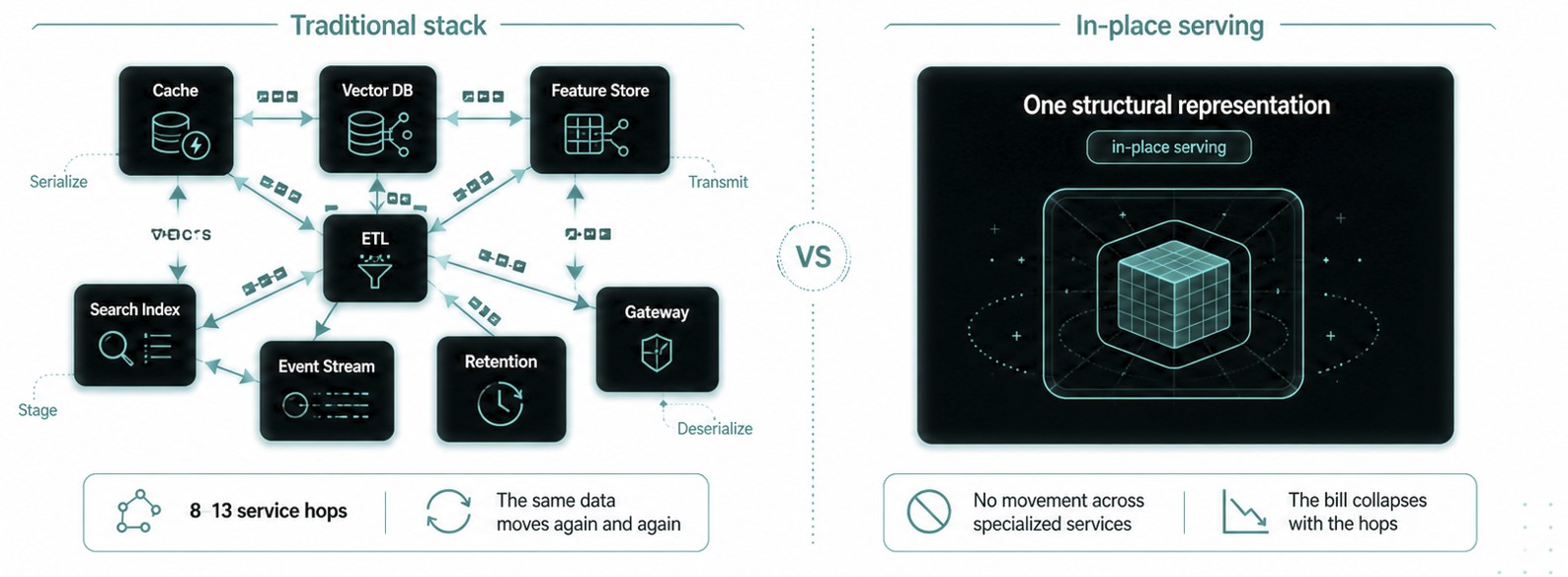
From hobbyist to hyperscaler, every piece of the inference puzzle is its own enterprise application, running its own workflow, demanding the client adapt to its specifications. Data is copied and re-encoded at every hand-off across the stack. Every copy has to live somewhere. Managing it is complicated and expensive. Estimating total cost is near impossible.
Architecture
Intelligence. Structure. Attestation.
The Atlas decides representation policy. HX-SDP serves one representation throughout inference. HX-Provenance attests when proof-bearing retrieval is required.
Internal intelligence layer
The Atlas
Fingerprints each workload, classifies spectral structure, and decides how data should be represented before it enters the serving path.
Decides representation policy →
Flagship structural data platform
HX-SDP
Serves embeddings, features, retrieval, search, retention, gateway, and observability from one GPU-native runtime.
Preserves one representation throughout inference →
Separate attestation product
HX-Provenance
Standalone exact retrieval and evidence attestation for regulated, audit-grade workflows. Produces proof-bearing receipts, manifests, hashes, and verifier-ready evidence bundles.
Produces proof-bearing receipts →
Atlas decides. SDP serves. Provenance attests.
Stack collapse
Why the stack collapses.
Data is not expensive to store. It is expensive to move. Every cache, vector database, feature store, search index, ETL path, event stream, retention layer, and gateway maintains another representation of the same signal. HX-SDP holds one representation in place, so movement collapses to one runtime.
Eight-service minimum replacement
HX-SDP replaces the minimum eight-service inference data stack.
- Cache
- Vector database
- Feature store
- Search index
- ETL pipeline
- Event stream
- Stream retention
- API gateway
On the platform page: HX-SDP addresses 12 workflows — 8 eliminated, 3 architecturally collapsed, and 1 simplified.
Representation-native data plane
One representation. Four access patterns.
Dense input is classified by The Atlas, factorized into a GPU-resident latent representation, paired with an SQ8 rerank sidecar, and served through four access patterns without reindexing or densifying in the hot path.
01
Input
Dense vectors, features, streams
02
Atlas
classify structure + policy
03
Latent
Z(N,r) + V_T(r,D)
04
SQ8
int8 sidecar rerank
05
Serve
cache · vectors · features · search
import { HolonomiX } from "@holonomix/sdk"

const hx = new HolonomiX({ apiKey: process.env.HX_API_KEY })
await hx.put("docs", vectors, { namespace: "prod" })
const hits = await hx.query("docs", query, { topK: 10 })
const features = await hx.serve("docs", { target: "gpu" })
Validated on NVIDIA
200 million entries. One H100. Exact recall.
The validated benchmark: 200M entries on a single H100 with 100% exact recall, 40.4 ms p50 query latency, 56.5 GB VRAM footprint, and 1,139× ingest throughput versus baseline. Distinct from the public 100M signed receipt and the 1B/2B scale envelope.
Validated benchmark
200M / 1× H100
- 100% exact recall
- 40.4 ms p50 query latency
- 56.5 GB VRAM footprint
- 1,139× ingest vs baseline
Public proof receipt
100M H100
Signed receipt with manifest, recall verification, and ML-DSA-65 signature available through the Proof Registry.
Open receipt →Scale envelope
1B / 2B
1B fp16 on H100, 2B fp16 on B200. Single-GPU capacity measurements, scoped accordingly.
Open benchmarks →Fit / no-fit
Qualified inbound beats vague inbound.
HX-SDP is strongest when structural reuse, GPU residency, proof-pack diligence, and private deployment matter. It is not positioned as unmanaged public-cloud self-service or universal high-concurrency serving.
Use HX-SDP when
Do not use HX-SDP yet when
Two audiences, one engine
Infrastructure teams get the data plane. Research teams get the technology core.
Most buyers start with HX-SDP. Strategic and research evaluators may need the broader HolonomiX core, the QTT/physics-native path, or HX-Provenance as a standalone evidence product.
Enterprise data infrastructure
Collapse cache, vectors, features, and search.
Start with HX-SDP if your team runs multiple stores around the same embeddings, feature vectors, or structured metadata.
Open HX-SDPTechnology core + proof
Evaluate the runtime, Atlas, and evidence chain.
Start with Technology, The Atlas, or HX-Provenance if your diligence is about the underlying computation, classifier behavior, or receipt architecture.
Access
Bring a workload. Get the correct tier and proof path.
Use the access lane for proof packs, technical evaluation, or private deployment scoping.